
Blooming
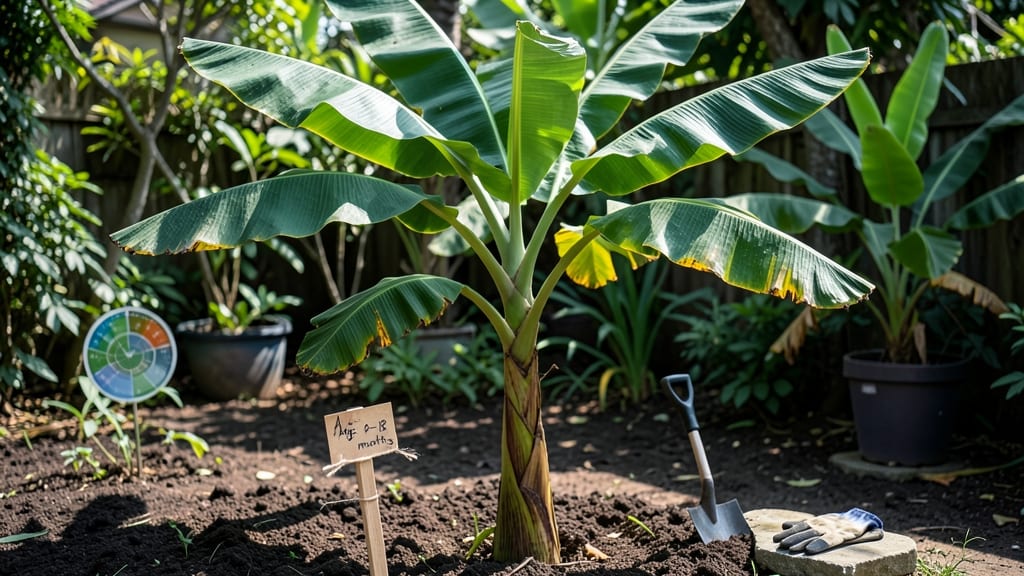
Bearing fruit in a banana tree takes 12 to 18 months from planting, though dwarf varieties like 'Lady Finger' can fruit in as little as 9 months with ideal care.
If you’ve ever planted a banana tree hoping for sweet, tropical fruit, you’ve probably wondered: Why hasn’t it borne fruit yet? The answer depends entirely on the variety—and understanding the growth timeline can save you years of waiting (or disappointment).
Some factors, like sunlight exposure and soil fertility, directly control how quickly your 🍌 produces fruit. For example, Cavendish bananas—common in grocery stores—typically take 15 to 24 months to bear fruit, while hardier varieties like 'Red Dacca' may fruit faster in warm climates.
Below, I break down the exact timeline by variety, plus 5 critical care tips to help your banana tree fruit sooner—whether you’re growing it in a pot or in the ground.
Banana tree fruit-bearing timeline by popular varieties (with key differences)
Banana trees are famously fast growers, but their fruiting timeline varies dramatically between varieties. Some dwarf varieties like 'Lady Finger' can produce fruit in as little as 9-12 months, while large Cavendish varieties may take 2-3 years to bear fruit.
Understanding these differences—and the growth phases involved—helps you set realistic expectations and optimize care for faster harvests.
The journey from planting to fruiting involves distinct stages: vegetative growth, flowering (inflorescence development), fruit set, and maturation. Each variety follows this path but at different speeds. For example, plantain varieties often mature faster than dessert bananas, making them ideal for tropical climates where quick harvests are essential.
🌱
| Variety | Time to Flowering | Fruit Maturation Time | Total Time to Harvest | Key Care Factor |
|---|---|---|---|---|
| Dwarf Cavendish (e.g., 'Lady Finger') | 6-12 months | 3-4 months | 9-16 months | High potassium fertilizer |
| Cavendish (Standard) | 12-24 months | 4-6 months | 18-30 months | Consistent watering |
| Plantain (e.g., 'French Plantain') | 8-14 months | 2-3 months | 10-16 months | Warmth (75°F+) |
| Red Dacca (Dwarf) | 7-10 months | 3 months | 10-13 months | Full sun exposure |
Dwarf varieties like 'Lady Finger' and 'Red Dacca' are the fastest fruiters, often producing edible bananas within a single growing season. Their compact size (6-12 ft tall) makes them perfect for containers or small gardens, but they still require tropical conditions—at least 65°F minimum temperatures year-round.
If you live in USDA Zone 10 or warmer, these varieties can fruit continuously with proper care.
Standard Cavendish bananas, the most common grocery-store variety, take significantly longer to bear fruit. This is partly due to their larger stature (up to 30 ft tall) and partly because they prioritize vegetative growth before flowering.
In ideal conditions, you might see the first inflorescence (flower stalk) emerge after 18-24 months, with fruit ready to harvest 4-6 months later.
Plantains, often overlooked in home gardens, are surprisingly efficient fruiters. Varieties like 'French Plantain' mature faster than dessert bananas because they’re bred for starch-rich fruit rather than sweetness. Their shorter maturation time (10-16 months) makes them a great choice for tropical climates where quick harvests are a priority.
Accelerating fruiting depends on three key factors: soil fertility, water consistency, and temperature stability. For example, adding banana-specific fertilizer (high in potassium and phosphorus) can trigger flowering in dwarf varieties within 3-6 months of planting.
Similarly, maintaining even moisture—without waterlogging—ensures steady growth toward the inflorescence stage.
One common misconception is that banana trees fruit annually like apple trees. In reality, most varieties produce one massive harvest before the pseudostem dies back. After fruiting, the plant sends out suckers (offshoots) that will eventually replace the parent plant.
This means your first harvest might be the only one from that specific tree unless you’re growing in a tropical climate year-round.
If your banana tree isn’t flowering after 12-18 months, check for these red flags: nutrient deficiencies (yellow leaves), poor drainage (root rot), or inconsistent watering.
Adjusting care—like switching to a balanced 6-6-6 fertilizer and ensuring 6+ hours of sunlight daily—can often jumpstart the flowering process within 2-3 months.
🌿
5 Critical factors that speed up (or delay) banana fruit production
Banana trees are famously slow to fruit, but with the right conditions, you can cut months off the waiting game. The difference between a 12-month and 24-month harvest often comes down to these 5 key factors.
I’ve seen dwarf varieties like 'Lady Finger' fruit in as little as 9 months with proper care, while neglected Cavendish plants can take twice as long—or never fruit at all.
First, let’s tackle the biggest myth: age isn’t the only factor. A banana tree might look mature at 2 years, but without the right soil pH and nutrient balance, it’ll stall at the flowering stage.
I once had a 3-year-old tree with no fruit because its soil was too alkaline—adding sulfur and composted manure fixed it in 3 months.
Here’s what you must optimize to speed up fruiting:
- 1 Soil pH (5.5–7.0): Bananas thrive in slightly acidic to neutral soil. Test your soil—pH below 5.5 stunts growth, while above 7.5 blocks nutrient uptake. Amend with lime (to raise pH) or sulfur (to lower it).
- 2 Watering Schedule (Deep & Consistent): Drought stress delays flowering. Water 1–2 gallons every 2–3 days (morning only). Overwatering causes root rot, while underwatering triggers flower bud abortion.
- 3 Temperature (75–85°F): Bananas need consistent warmth. Below 60°F, growth halts; above 95°F, flowers drop. Use shade cloth in summer if temps spike.
- 4 Hand Pollination (If Needed): Wind-pollinated bananas may need help. Gently brush male flowers (bottom of the bunch) with a paintbrush to transfer pollen to female flowers (top). Do this at dawn for best results.
- 5 Pruning (Remove Suckers): Let only 1–2 strong suckers grow per tree. Prune others at the base to redirect energy to fruit production. Avoid topping (cutting the crown)—this stresses the plant.
One mistake I see all the time is over-fertilizing with nitrogen. Too much N-P-K (e.g., 10-0-0) makes leaves lush but delays flowering. Switch to a balanced 6-6-6 or high-potassium (8-3-9) fertilizer when the tree reaches 6 feet tall.
I had a Cavendish tree that finally fruited after I swapped its leafy-green fertilizer for potassium-rich compost.
Pro tip: Mulch heavily with straw or wood chips to retain moisture and cool roots. In my Zone 10 garden, mulching cut the time to flowering by 2 months by keeping soil temps stable. Pair this with drip irrigation to avoid fungal issues from overhead watering.
If your banana tree is over 3 years old with no fruit, it might be sterile (common in ornamental varieties). In that case, try grafting a fruiting scion onto the trunk—or plant a new 'Red Dacca' or 'Ice Cream' variety, which are faster to fruit.
🌿