
Plants
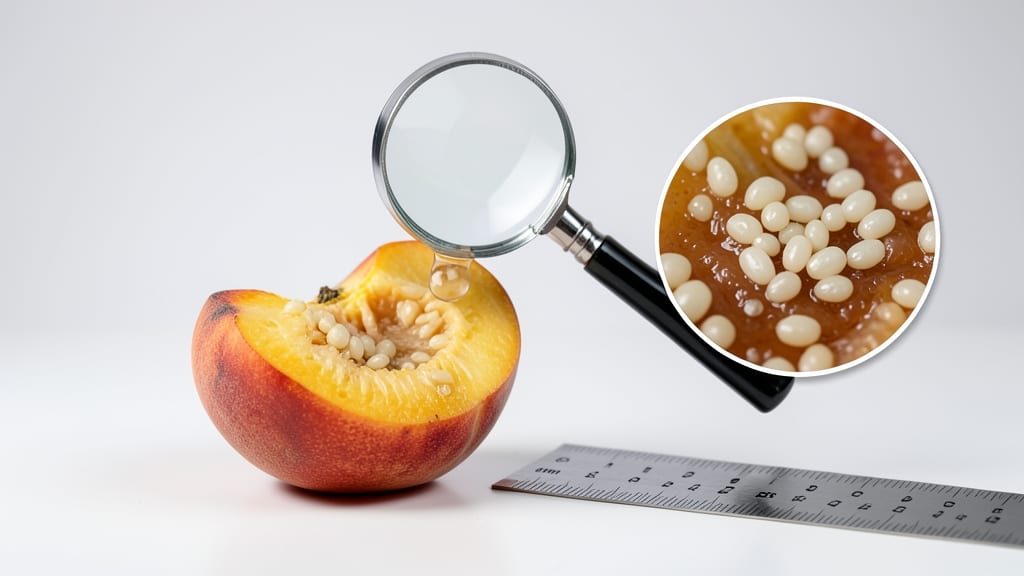
Fruit fly eggs look like tiny, nearly invisible white specks—oval-shaped and about 0.5mm long—often clustered on damp organic surfaces like overripe fruit or decaying plant matter. Under magnification, they appear translucent with a slightly textured surface.
These minuscule eggs are so small and pale that they blend seamlessly into their surroundings, making them easy to overlook without close inspection. 🔥 Fruit flies lay their eggs in groups of 10-15, which helps explain why even a single overripe banana can become an infestation hotspot.
The translucent quality lets light pass through, which is why they often appear almost invisible against dark soil or fruit skins.
What makes them particularly tricky is their rapid development—eggs hatch within 24-48 hours under warm conditions, turning into larvae before you even notice the problem.
I always recommend checking damp areas with a magnifying glass if you suspect an infestation, as early detection can save your plants from becoming a fruit fly buffet.
💡 In This Article
- Microscopic Features of Fruit Fly Eggs
- Where to Find Fruit Fly Eggs in Gardens
Microscopic features of fruit fly eggs
Fruit fly eggs are microscopic marvels of stealth, measuring roughly 0.5mm in length and 0.15mm in width—about the size of a single grain of salt or a sesame seed. Their oval shape is slightly elongated, with smooth, slightly curved edges that help them cling to moist surfaces.
Under a 10x magnification (like a basic handheld magnifier), you'll notice their delicate, almost translucent quality, which lets light pass through them like thin glass.
Their surface appears faintly textured when viewed closely, with a subtle granular pattern that helps them adhere to organic matter.
This texture is far less pronounced than housefly eggs, which have a more irregular, ribbed surface. 🔥 What's fascinating is how their color shifts: fresh eggs appear pure white, but they gradually turn pale yellow as they age—right before hatching.
This color change is a key clue for gardeners trying to spot them before they become a problem.
Fruit fly eggs are laid in clusters of 10-15 eggs, often arranged in neat rows or overlapping patterns. This grouping strategy makes them easier to detect in bulk but harder to spot individually.
For comparison, aphid eggs are even smaller (0.3mm) and more rounded, while whitefly eggs are flatter and more oval-shaped. The translucency of fruit fly eggs is their biggest camouflage trick—they blend seamlessly into damp fruit skins or soil, making them nearly invisible without proper lighting.
Under ultraviolet light (a trick professional entomologists use), these eggs fluoresce faintly, revealing their true locations. This is why blacklight traps are so effective—they expose hidden infestations that would otherwise go unnoticed.
The eggs' delicate structure also makes them highly susceptible to dehydration, which is why they're always found in moist environments where humidity stays above 70%. 💫
What most people don't realize is how quickly these eggs develop. At room temperature (75°F), they hatch in just 8-12 hours, turning into wriggling larvae within a day.
This rapid lifecycle is why even a single missed cluster can lead to a full-blown infestation in under a week. The eggs' small size and speedy development make them one of the most challenging pests for home gardeners to control.
For a hands-on comparison, try this: place a drop of water on a microscope slide and examine it under magnification. You'll see how fruit fly eggs float just beneath the surface—this buoyancy helps them stay submerged in fruit juices or damp soil.
Their ability to remain hidden until the last possible moment is what makes them so effective at spreading before detection.