
Trees
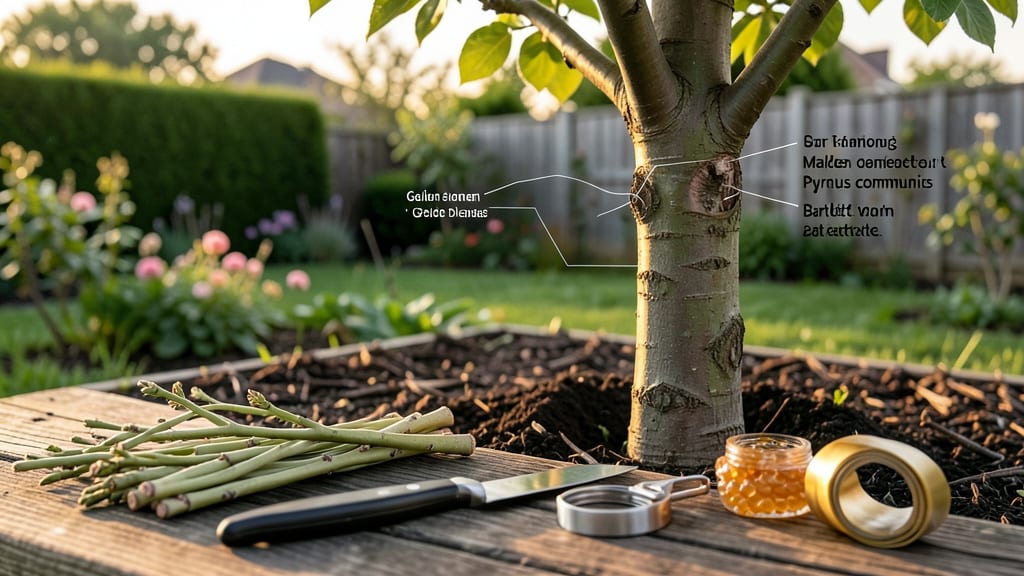
Spliced fruit trees create a single tree bearing multiple fruit varieties through grafting or budding, perfect for maximizing small gardens or achieving unique harvests. Mastering this technique demands careful timing and horticultural skill to ensure strong growth and fruit quality.
Creating spliced fruit trees lets you grow two or more fruit varieties on one tree, saving space while expanding your harvest options. 🌳 The process involves carefully joining a rootstock (the established tree) with scion wood (buds or shoots from the desired fruit variety) during its active growing season, typically late winter or early spring.
This isn't just a novelty—it's a practical solution for gardeners with limited room who still want variety, like growing both sweet and tart apple varieties on one tree. The key to success lies in selecting compatible varieties and giving the grafted sections proper care during the critical healing period.
One of the biggest advantages is the space efficiency—what would normally take three separate trees becomes one elegant, multi-fruit solution. 🍎✨ However, it's important to note that not all fruit combinations work well together, and some may produce lower yields than dedicated single-variety trees.
For best results, I recommend starting with proven compatible pairs like apple-pear or citrus-citrus combinations, and always use certified disease-free scion wood to prevent problems down the road.
💡 In This Article
- How Grafting Creates Spliced Fruit Trees
- Best Fruit Combinations for Spliced Trees
How grafting creates spliced fruit trees
The biological magic behind spliced fruit trees happens through grafting, where two plant parts—rootstock and scion—merge to form a single, genetically diverse tree. The rootstock provides the established root system and nutrients, while the scion contributes the desired fruit characteristics.
Three primary grafting methods exist: whip-and-tongue (for precise bark alignment), cleft grafting (for thicker rootstocks), and bark grafting (ideal for dormant-season work). Each technique ensures the vascular cambium layers align perfectly, allowing nutrient and water flow between the joined sections. 🌱
Seasonal timing is everything—most successful grafts occur during the tree's active growth phase, typically late winter to early spring when sap flows freely. For example, apple trees graft best between February and April, when the bark slips easily from the wood.
The rootstock must be healthy, with a diameter matching the scion wood (typically ¼ to ½ inch thick). Compatibility matters too: apple scions won't thrive on pear rootstocks unless they're closely related varieties, like 'Honeycrisp' on 'Antonovka' rootstock.
This precision ensures the graft "takes" within 4-6 weeks, forming a strong union.
Scion selection determines fruit quality and yield. Choose disease-resistant varieties with compatible growth habits—aggressive scions can overpower weaker rootstocks. For instance, pairing a dwarfing rootstock (like M9) with a semi-dwarf scion creates a compact tree perfect for containers.
The first year after grafting focuses on healing; prune lightly to encourage callus formation at the graft union. By year two, you'll see new shoots emerging from both scions, signaling success. 🌿
Rootstock choice impacts more than just size. Semi-dwarf rootstocks (e.g., MM106) produce trees 6-8 feet tall, while standard rootstocks yield full-size trees. Citrus splices often use trifoliate orange rootstock for cold tolerance, while apple-pear splices rely on Malling-Merton rootstocks.
The rootstock's disease resistance becomes the tree's first line of defense—poor choices lead to blight or decline. Always source scions from reputable nurseries to avoid introducing pathogens.
Visual cues confirm a successful graft: the graft union should swell slightly, and new shoots should emerge uniformly from both scions. If one side fails to grow, the graft may have rejected it.
In citrus splices, you might see lemon and orange branches growing side by side, each bearing its own fruit type. The tree's canopy will naturally separate into distinct sections over time, making harvests organized by variety.
This spatial efficiency is why spliced trees thrive in urban gardens or patios where space is limited. 🍊
Advanced gardeners can even create three-way splices, though this requires extra skill. The process involves grafting two scions onto a single rootstock, creating a tree with three distinct fruit types.
For example, a lemon, lime, and calamansi splice yields a year-round harvest of citrus varieties in one compact form. However, yield per variety may drop by 20-30% compared to single-variety trees. The trade-off? A single tree that produces three unique flavors in the same season.