
Size
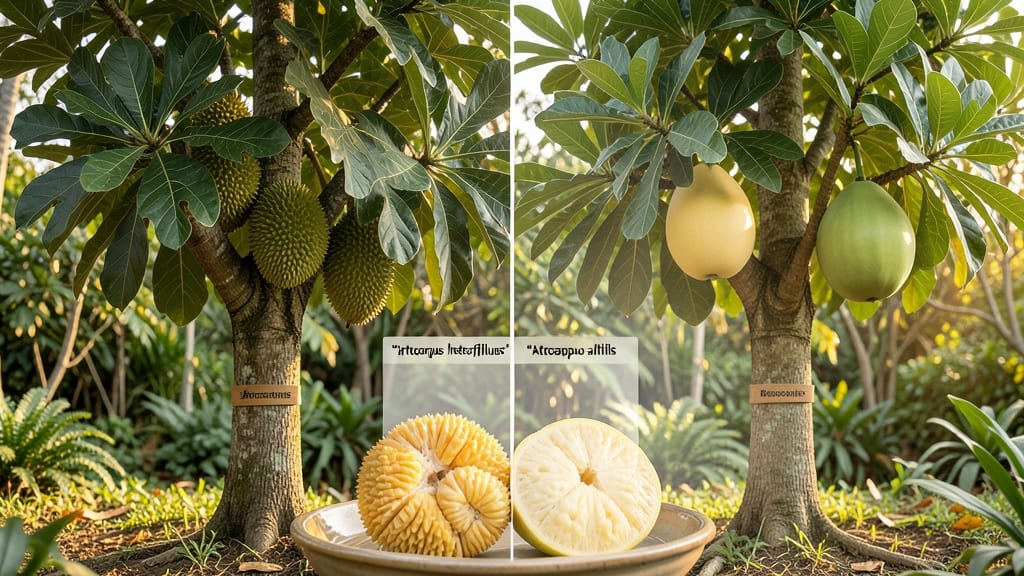
Jackfruit and breadfruit aren't the same: jackfruit offers a sweet, fibrous texture perfect for desserts or meat substitutes, while breadfruit delivers a starchy, potato-like consistency ideal for savory dishes. Their distinct botanical families and growing habits create completely different culinary experiences.
These two tropical fruits often get confused because they share a similar name, but their botanical origins and culinary roles couldn't be more different. 🌿 Jackfruit comes from the Artocarpus heterophyllus tree and thrives in tropical climates across South and Southeast Asia, while breadfruit (Artocarpus altilis) originates from the Pacific Islands.
The key difference lies in their growth patterns—jackfruit develops as a large, spiky fruit with edible pulp and seeds, whereas breadfruit grows as a dense, potato-like fruit with a thick, starchy interior.
Their distinct structures directly impact how we use them in the kitchen. Ripe jackfruit's sweet, fibrous texture makes it perfect for smoothies, desserts, or even as a meat substitute in dishes like tacos or curries.
Meanwhile, breadfruit's neutral, starchy profile shines when roasted, fried, or mashed like potatoes. Understanding these differences means you can choose the right fruit for your recipe without any guesswork.
💡 In This Article
- Botanical and Culinary Differences Between Jackfruit and Breadfruit
- How to Use Jackfruit and Breadfruit in Cooking
Botanical and culinary differences between jackfruit and breadfruit
Jackfruit and breadfruit belong to the same genus (Artocarpus), but their species names—Artocarpus heterophyllus for jackfruit and Artocarpus altilis for breadfruit—reveal their distinct botanical identities. Jackfruit grows on trees reaching 30-40 feet tall, producing football-sized fruits covered in sharp, thorn-like spikes.
Its flesh is segmented into 100-500 bulbous pods, each containing sweet, fibrous pulp and a single large seed. Breadfruit, meanwhile, grows on trees up to 80 feet tall, yielding dense, potato-like fruits with smooth, green or yellow skins and a thick, starchy interior.
Their native regions further highlight their differences. Jackfruit thrives in the tropical climates of South and Southeast Asia, particularly in India, Thailand, and Indonesia, where it's cultivated for both its fruit and wood. Breadfruit, however, originates from the Pacific Islands and was historically a staple food for Polynesian cultures.
This geographic separation shaped their culinary roles—jackfruit's sweetness and fibrous texture make it ideal for desserts and meat substitutes, while breadfruit's neutral, starchy profile aligns with savory dishes like roasted sides or fried snacks.
Texture plays a pivotal role in their culinary applications. Ripe jackfruit's pulp has a soft, custard-like consistency with a mild sweetness and floral aroma, while its seeds offer a nutty crunch.
Breadfruit, when ripe, becomes soft and grainy, similar to a cooked potato, with a mild, slightly sweet flavor that intensifies when cooked. Unripe breadfruit is even firmer and starchier, resembling a cross between a potato and a chestnut.
This contrast explains why jackfruit excels in sweet dishes (like halwa or smoothies) while breadfruit shines in savory preparations (such as roasted breadfruit chips or mashed breadfruit as a potato substitute).
Even their growth habits differ dramatically. Jackfruit trees produce fruit year-round in tropical climates, with each tree yielding 50-100 fruits annually. Breadfruit trees, however, are more seasonal and require 4-6 years to mature before bearing fruit.
This slower growth cycle contributed to breadfruit's historical significance as a sustainable crop for island communities, where it could be stored for months without spoiling. 🌱
Another key distinction lies in their chemical composition. Jackfruit's pulp contains high levels of natural sugars (glucose and fructose), giving it a caramel-like sweetness when cooked. Breadfruit, on the other hand, is rich in resistant starch, which digests slowly and provides long-lasting energy—similar to how potatoes fuel athletes.
This starch content also makes breadfruit a gluten-free alternative for thickening sauces or binding dishes, a role jackfruit cannot fulfill due to its high moisture and sugar content.
Consider this comparison when shopping: jackfruit's spiky exterior and segmented interior scream "dessert or meat substitute," while breadfruit's smooth, dense form signals "savory starch." Their differences aren't just superficial—they're rooted in biology, geography, and human culinary innovation across continents. 🌏